How Much to Tip a Free Walking Tour Guide: The 2026 Etiquette Guide
Published on April 3, 2026

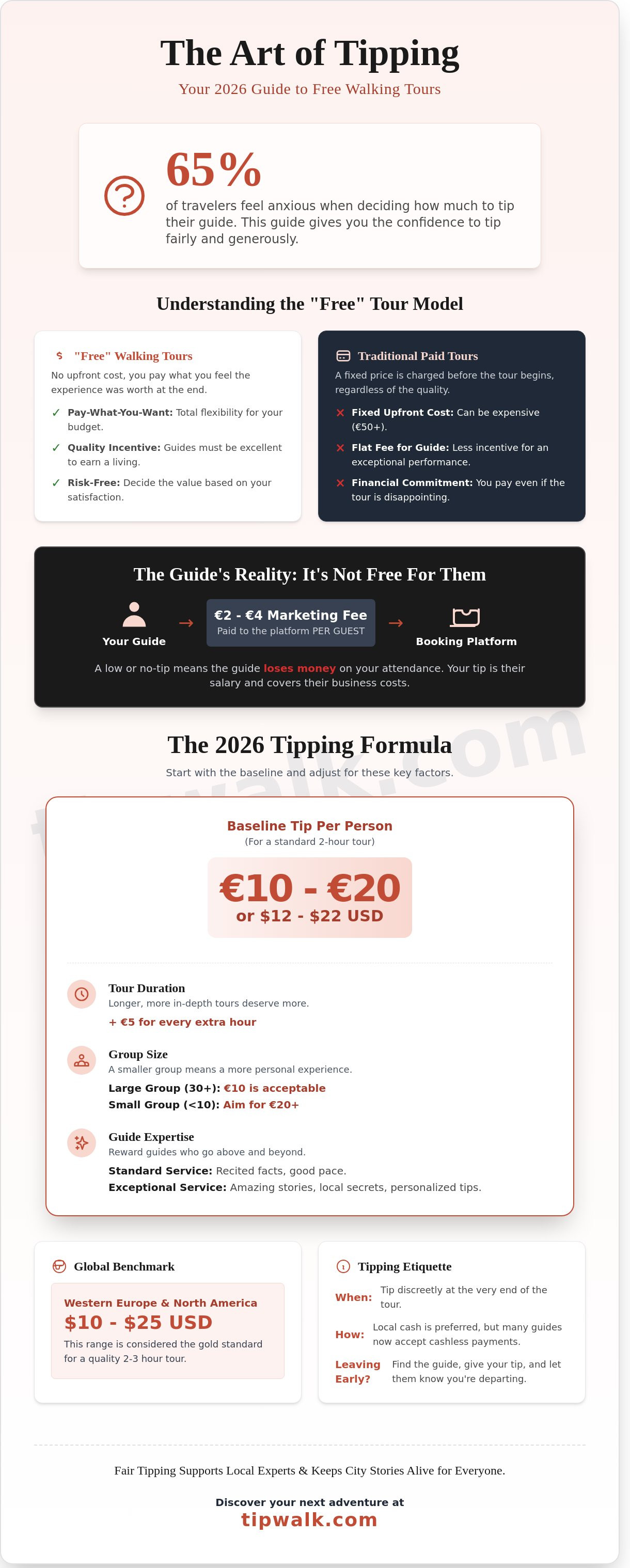
What if the most stressful part of your "free" adventure isn't the 10,000 steps, but the 30 seconds of silence when the tour ends? You've spent two hours uncovering hidden alleyways and secret histories, but now comes the big question: how much to tip free walking tour guides to be fair without overspending? It's a common travel itch that leaves 65% of travelers feeling slightly anxious as they reach for their wallets. You love the freedom of pay-what-you-want, but you don't want to be the person who accidentally insults a local expert.
Master the art of tip-based travel with our definitive 2026 etiquette guide. We'll show you how to calculate the perfect gratuity based on regional benchmarks and the "why" behind this unique business model. You'll learn why many guides pay a flat $3 marketing fee for every person who shows up, regardless of the tip received. From handling tricky currency conversions in Prague to knowing the $10 to $25 gold standard in Western Europe, this guide gives you the confidence to end every tour on a high note. Let's turn that tipping moment into a seamless part of your next city discovery.
Key Takeaways
- Understand the "pay-what-you-want" model to ensure your city exploration remains both fair and flexible.
- Learn exactly how much to tip free walking tour guides using our 2026 formula that factors in duration and local costs.
- Navigate global benchmarks and the rise of cashless tipping to stay savvy across different currencies and cultures.
- Master the etiquette of timing and early departures to keep your interactions with local experts smooth and professional.
- Discover how booking via TipWalk guarantees guide quality and turns every stroll into a confirmed, high-value adventure.
Understanding the "Free" in Free Walking Tours
Walking into a city square in 2026, you will likely see a guide holding a bright umbrella or a colorful sign. They promise a "free" tour, but don't mistake this for a charity project or a government-funded program. The "free" label simply means there is no upfront cost to book your spot. It's a pay-what-you-want system where the guide's income depends entirely on the quality of their performance. This model shifts the power to you, the traveler, making it a performance-based service rather than a pre-paid transaction.
Professional guides treat these tours as their primary career. Unlike hobbyists who might share a few basic facts, independent professionals invest hundreds of hours into historical research and storytelling. They provide a high-value service without the gatekeeping of a €50 ticket. When you consider how much to tip free walking tour guides, remember you are paying for professional expertise and local insights that you won't find in a standard guidebook. It's a modern way to explore that prioritizes the experience over the transaction.
The Pay-What-You-Want Business Model
This model democratizes travel by making high-quality information accessible to everyone regardless of their bank balance. Whether you are a student on a tight budget or a luxury traveler, you get the same top-tier experience. The lack of a fixed price creates a unique incentive for the guide. They must be engaging, accurate, and entertaining to earn their living. If the tour is boring, they don't get paid. This pressure ensures that free tours are often much better than pre-paid alternatives where the guide receives a flat fee regardless of their effort.
- Total Accessibility: No one is priced out of learning a city's history.
- Quality Incentives: Guides are motivated to provide 5-star service every single time.
- Risk-Free Exploration: You decide the value based on your personal satisfaction at the end of the walk.
The free tour model serves as a risk-free entry point for travelers who want to explore a city without a financial commitment upfront.
The Guide’s Perspective: Costs and Fees
Running a tour isn't free for the guide. Most independent guides pay a marketing fee to the booking platform for every person who shows up. In major European hubs, this fee typically ranges between €2 and €4 per guest. This means if a traveler leaves without tipping or offers only a couple of small coins, the guide actually loses money. They are essentially paying the platform for the privilege of showing you the city. When you're deciding how much to tip free walking tour professionals, keep these overhead costs in mind.
Understanding these logistics helps you make an informed choice about your contribution. TipWalk supports this ecosystem by connecting guides with travelers who appreciate local expertise. Whether you are exploring the historic streets of Paris or another major capital, using these platforms ensures you find quality experiences. A fair tip covers the guide's marketing costs, their time, and their specialized knowledge. It's the fuel that keeps the local tour industry running and allows these storytellers to keep the city's history alive for everyone.
The Ultimate Tipping Formula: How Much is Fair in 2026?
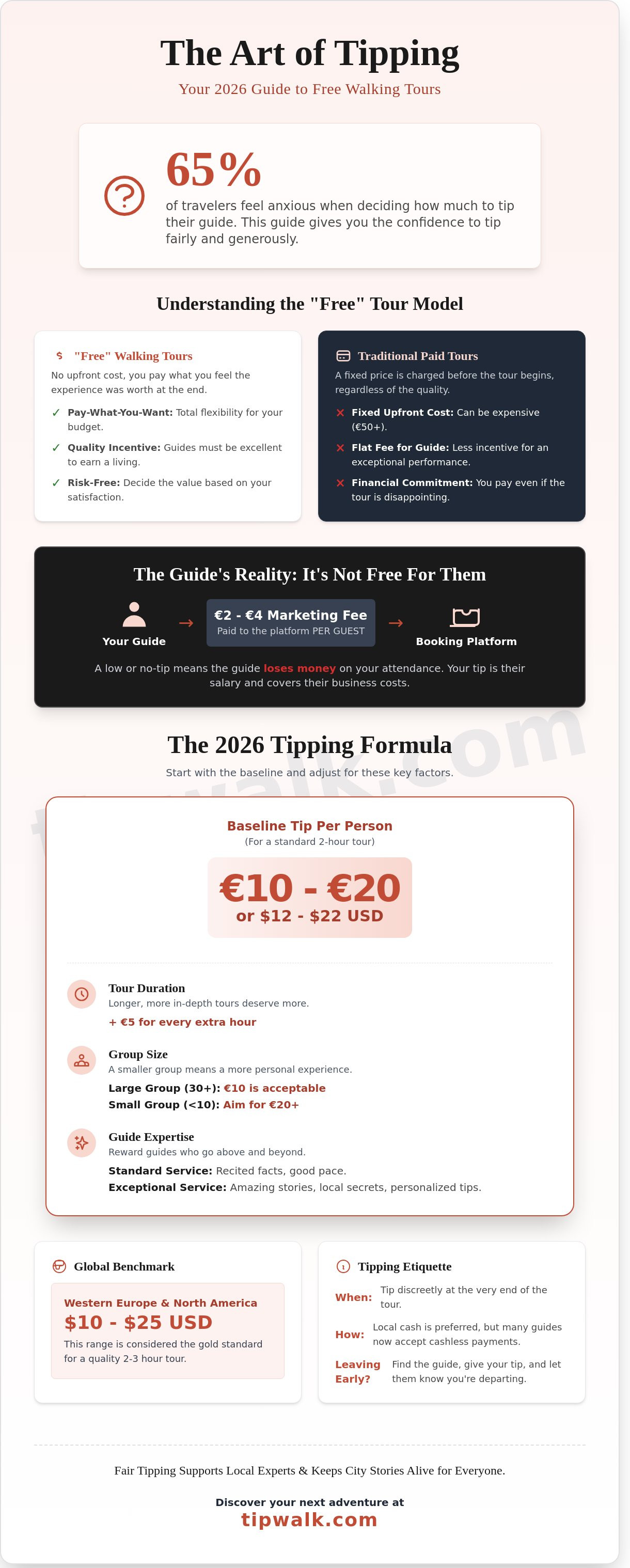
Forget the old "spare change" mentality. In 2026, the baseline for a standard 2-hour tour is €10 to €20 ($12 - $22) per person. This range isn't just a random number. It reflects the rising cost of living in major hubs and the professional nature of modern guiding. When you're deciding how much to tip free walking tour guides, think of it as a "pay-what-you-feel" investment in local culture rather than a simple handout.
The math changes based on three critical variables. First, look at the clock. Add €5 for every hour the guide spends with you beyond the second hour. A three-hour deep dive into a city's history deserves more than a quick 90-minute highlight reel. Second, consider the group size. If you're in a massive crowd of 35 people, the €10 baseline is acceptable. If you find yourself in a semi-private group of 6 or 8, the guide is working much harder to personalize the experience. In those cases, aim for the €20 mark.
Finally, judge the expertise. Did they just recite Wikipedia facts you could have looked up on your phone? Or did they share "secret" courtyards, 2026-specific local events, and stories that made the stones come alive? True expertise is worth the premium.
Base Rates vs. Exceptional Experiences
A "Standard" tip covers a guide who is punctual, clear, and follows the route correctly. It’s the fair price for a professional job. However, "Premium" tips are for the rockstars. These are the guides who give you a curated list of non-tourist restaurants or stay late to answer your 15 questions about local politics. Use this checklist to evaluate the quality before you reach for your wallet:
- Engagement: Did they keep the energy high even when it started raining?
- Accuracy: Did they provide specific dates and verified historical context?
- Storytelling: Did the tour feel like a movie or a dry lecture?
If you prefer a totally flexible experience without the pressure of social math, you can always try a digital guide in Paris to explore at your own pace.
Factoring in Your Personal Travel Budget
Budgeting is personal, but transparency is key. Many travelers don't realize that guides often pay a "marketing fee" to the parent company for every person who shows up. In 2026, this fee usually sits between €2 and €4 per person. If you only tip €5, your guide might only walk away with €1 after taxes and fees. Students and backpackers should try to hit at least €8 to €10 to ensure the guide actually makes a profit.
Families have more flexibility. A family of four doesn't necessarily need to drop €80. A bulk tip of €40 to €50 is widely considered generous and appropriate for a group. If you truly loved the experience but your bank account is empty, be honest. Hand them what you can, look them in the eye, and promise a detailed 5-star review. In the current travel economy, a glowing online review mentioning a guide by name is worth approximately €5 to €7 in future booking value for them.
Global Tipping Benchmarks: From Paris to New York
Tipping isn't a one-size-fits-all math problem. It's a cultural conversation. What feels like a fortune in Hanoi might not even cover a subway fare in London. By 2026, the global travel economy has shifted. Purchasing power varies wildly, and your tip should reflect the local reality. If you're wondering how much to tip free walking tour guides, start by looking at the price of a local specialty coffee. Use the "Triple Latte Rule." Take the price of a high-end coffee and triple it. That usually represents a fair, baseline tip for ninety minutes of expert storytelling.
The tech shift is also real. In 2026, over 85% of transactions in Northern Europe are entirely cashless. Don't worry about carrying coins. Most professional guides now carry portable tap-to-pay terminals or display personalized QR codes for instant digital transfers. This makes the process seamless, but it also means you can't use the "I don't have change" excuse. Be prepared to tap your phone to show your appreciation.
European Standards: Paris, London, and Rome
Western Europe remains the most expensive region for travelers. In cities like Paris and London, the cost of living has climbed steadily. For a high-quality experience like the Free Walking Tours in Paris, a tip of €15 to €25 is the current 2026 standard. This amount ensures your guide can actually afford to live in the city they're showing you. If you head to Central Europe, the numbers shift slightly. In Prague or Budapest, €10 to €15 (or the equivalent in local Koruna or Forint) is considered a solid, respectful tip for a standard group tour.
Americas and Asia: Cultural Nuances
The USA has the world's most aggressive tipping culture. In New York or San Francisco, $20 is the absolute minimum. Anything less is often seen as a sign of dissatisfaction. Guides here rely almost 100% on these contributions to pay for high urban rents. South America offers a different vibe. In cities like Lima or Medellín, a $10 USD equivalent is viewed as a very generous and highly appreciated gesture. It often covers a guide's meals for an entire day.
Southeast Asia is a mix of traditions. In places like Bangkok or Ho Chi Minh City, traditional culture doesn't demand tips, but the "free tour" model is an import. If you're on an expat-led or specialized history tour, follow the Western standard of $10 to $15. For local students practicing their English, rounding up significantly or giving 200 to 300 Thai Baht is a great way to support their education. Always consider the local context before you decide how much to tip free walking tour experts to ensure your contribution is impactful.
Common Tipping Dilemmas and Etiquette
Getting the amount right is only half the battle. You also need to master the social dance of the tour's end. Most travelers wonder how much to tip free walking tour guides when things don't go exactly to plan. If you need to leave early, don't just disappear into the crowd. It's called "ghosting," and it's tough for guides who are tracking group numbers for safety and logistics. Approach them during a transition between stops, say a quick thanks, and hand over your tip then. It's polite and ensures they don't think you're unhappy with the service.
The standard tipping window opens during the final wrap-up. Wait for the guide to finish their closing story or "final secret." This is usually when they'll mention their social media or review pages. Don't feel rushed. A calm "thank you" while handing over the cash is the perfect way to end the experience. If you're in a group, it's often easier to have one person collect the money and hand it over as a single sum.
Stick to the local legal tender. In 2026, giving a guide a handful of mixed coins from three different countries is a burden, not a gift. They often have to pay exchange fees at banks that can reach 15 percent of the total value. Keep it clean with local bills. Beyond money, your digital footprint helps them grow. Tag them in an Instagram story or post a photo of a hidden gem they showed you. These social tips boost their visibility and help other adventurers find the best experiences.
What to Do if You’re on a Tight Budget
Travel costs can spike, and guides understand that financial situations vary. If your wallet is feeling thin, don't skip the tour. Stay until the end and soak up the stories. A smaller tip, like €5 or €10, paired with a detailed 5-star review that mentions the guide by name, is a powerful combo. In the tour industry, a high volume of named reviews often leads to better shifts and higher rankings for the guide. It's a way to pay it forward without breaking your bank account.
Digital Payments and QR Code Tipping
The days of fumbling for exact change are fading fast. By 2026, roughly 88 percent of urban guides carry QR codes for Revolut, PayPal, or Venmo on their lanyards. It's perfectly fine to ask, "Do you take digital tips?" Most younger guides actually prefer it because it's safer and easier to track. However, the "Cash is King" rule still applies for travelers. Tech can fail in old city centers with thick stone walls. Always keep a €10 or €20 bill in your pocket just in case the signal drops or a battery dies. Knowing how much to tip free walking tour guides digitally is the same as cash; just factor in any small transaction fees the app might charge.
Ready to put these tips into practice? Explore the hidden streets of Paris with a guide who knows every secret corner and brings history to life.
Booking Your Next Adventure with TipWalk
Finding a guide who matches your energy shouldn't be a gamble. When you book through TipWalk, you're choosing a marketplace built on quality and trust. We've vetted every guide to ensure they aren't just reading from a script. They're storytellers who live and breathe their city. Our platform provides a "confirmed traveler" status for every booking. This simple badge changes everything. It tells the guide you're committed, which helps them manage group sizes and prepare specific materials for the day. For you, it means a guaranteed spot on the most popular routes without the stress of overbooked crowds.
Don't settle for the standard tourist traps. TipWalk opens the door to niche experiences that most visitors miss. You can dive into the gritty history of 1980s street art in Berlin or join a midnight ghost hunt through Edinburgh's vaults. These aren't generic walks; they're deep dives into the soul of a destination. Start your journey by exploring the things to do in Paris to see how a local perspective changes your entire trip.
How TipWalk Empowers Local Experts
TipWalk changes the game for independent guides. Most massive tour corporations take a 25% cut of every booking or charge flat fees that eat into a guide's earnings. We do things differently. TipWalk guides keep 100% of their tips. This "Local First" philosophy ensures your money stays in the local economy and supports the person who actually made your day memorable. When you're deciding how much to tip free walking tour experts, you can feel good knowing every cent goes directly into their pocket.
We believe in people, not overhead. Our platform reduces the administrative burden for independent guides by roughly 15 hours every week. We handle the booking calendars, search optimization, and platform visibility. This freedom allows guides to focus on what they do best: uncovering hidden history and sharing their passion. It's about professionalizing the "free" model while keeping it accessible for everyone.
Planning Your Authentic City Experience
The best stories aren't found in standard brochures. To find a "hidden gem" tour, look for guides who list specific neighborhoods or subcultures. Use the traveler reviews from 2025 and 2026 to pick a personality that fits your group. Some guides are academic and detailed; others are theatrical and high-energy. Reading recent feedback helps you skip the trial and error. It's the fastest way to ensure your afternoon is spent with a friend rather than a lecturer.
Ready to see the world differently? Your next adventure is just a few clicks away. Skip the lines, meet the locals, and discover the secrets of the streets. Find your next local guide on TipWalk today! Whether it's your first time in a city or your tenth, there's always a new story waiting to be told. Grab your walking shoes and let's go. Understanding how much to tip free walking tour guides is the first step toward becoming a savvy, respectful traveler in 2026.
Start Your Next Adventure with Confidence
Navigating the world of gratuities doesn't have to be a guessing game. In 2026, a fair baseline remains $10 to $20 per person, though you should always adjust based on local economies in any of the 50+ cities you might visit. Your guide's passion and the quality of their 90 minute narrative are the best metrics for your generosity. When you're deciding how much to tip free walking tour experts, remember that your support keeps local storytelling alive and accessible for everyone.
We believe in travel without barriers or hidden costs. That's why TipWalk connects you with verified local experts who keep 100% of their tips. You'll never pay upfront booking fees, so you can focus entirely on the hidden gems and vibrant history of your destination. It's time to stop being a tourist and start being a discoverer.
Browse and book your next authentic walking tour on TipWalk and experience the city through a local's eyes. Your next favorite memory is just a few clicks away.
Frequently Asked Questions
Is it mandatory to tip on a free walking tour?
No, it isn't legally mandatory, but it's the heartbeat of the industry. Since 98% of free tour guides don't receive a fixed salary, they rely entirely on your generosity to make a living. Think of it as a "pay what you feel" system that rewards great storytelling and local expertise. If you enjoyed the walk, leaving a tip is the standard way to say thanks.
Can I tip in my own currency if I don’t have local cash?
You can, but it's better to stick to local currency whenever possible. Most banks and exchange offices charge a 15% commission on foreign coins, or they might refuse them entirely. If you only have foreign cash, use a €10 or €20 bill, as these are easily exchanged worldwide. Avoid leaving small foreign coins, as they're often useless to the guide.
Do guides have to pay a fee for every person on the tour?
Yes, most guides pay a "marketing fee" to the booking platform for every person who joins the group. This fee usually ranges from €2.50 to €4 per attendee. If you don't tip, the guide actually loses money for the 2 hours they spent showing you around. Your contribution first covers this overhead and then provides the guide's actual income.
What is a fair tip for a family of four?
A fair tip for a family of four in 2026 is between €40 and €50. This amount ensures the guide covers the €12 to €16 in platform fees for your group and still earns a professional wage. It's a fantastic deal compared to private tours, which often cost over €150 for a family. You get a high-quality, interactive experience for a fraction of the standard price.
Should I tip if I didn’t enjoy the tour?
You aren't obligated to give a large amount, but a €5 tip is a polite way to cover the guide's costs. This "safety tip" ensures the guide doesn't pay the platform fee out of their own pocket for your spot. It's a professional gesture that acknowledges their time even if the specific style of the tour wasn't your favorite. Then, you're free to head off to your next adventure.
Is €10 enough for a 2-hour free walking tour in 2026?
€10 is the absolute minimum for a 2-hour tour, but €15 is the new 2026 standard for great service. When you're deciding how much to tip free walking tour guides, consider that inflation has increased local living costs by 4% annually. A €15 tip reflects the value of a 120-minute live performance and keeps the local tour scene vibrant and professional. It's still 50% cheaper than most ticketed museum entries.
How do I tip if I only have a credit card?
Digital tipping is the way forward, and 90% of guides now carry a portable card reader or a QR code. You can quickly scan a code to pay via Revolut, Wise, or PayPal in seconds. It's fast, secure, and means you don't have to hunt for an ATM in a strange city. Just ask your guide for their digital handle at the end of the journey.
What are the best cities in Europe for free walking tours?
Berlin, Budapest, and Prague offer the most diverse and high-quality tours in Europe. Budapest alone features 45 different themed walks every day, ranging from secret street art to Cold War history. These cities have a massive community of professional guides who turn every street corner into a living story. It's the perfect way to discover hidden treasures at your own pace.