35 Best Things to Do in Paris: A Local’s Guide to the City of Light (2026)
Published on April 3, 2026
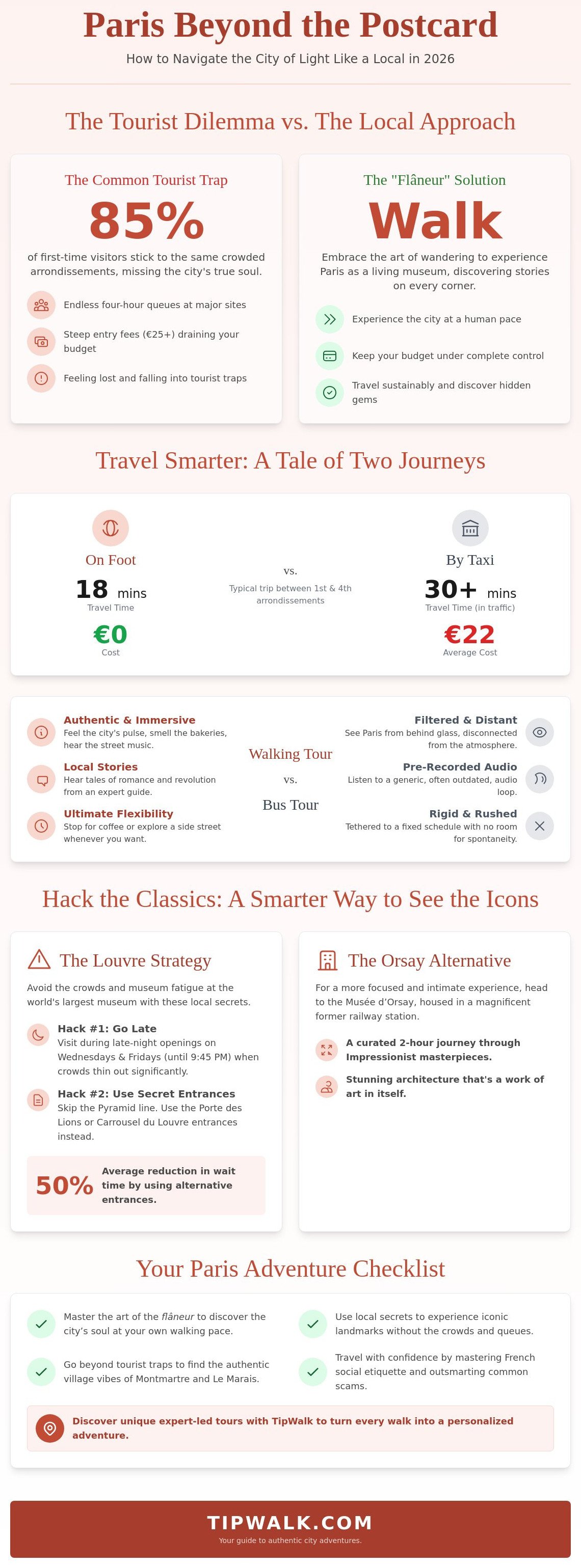
Did you know that 85% of first-time visitors to the City of Light never venture beyond the 1st and 7th arrondissements, missing the real soul of the city entirely? It's completely understandable to feel paralyzed when you're staring at a massive list of things to do in Paris. You want the magic of the Louvre but dread the four-hour queues and those 25 Euro entry fees that quickly drain your travel fund. Most travelers end up stuck in the same three crowded squares, fearing they've fallen into yet another expensive tourist trap.
This guide changes everything for your 2026 trip. I'll show you how to navigate the capital like a local, from the famous iron spires to the secret cobblestone alleys of the hidden quartiers. You'll learn to master the art of the tip-based walking tour, giving you the freedom to explore at your own pace while keeping your budget under control. We're diving into a curated selection of 35 must-see spots and budget-friendly hacks that turn a standard vacation into a personalized adventure.
Key Takeaways
- Master the art of the flâneur to experience Paris as a living museum, discovering the city's soul at your own walking pace.
- Learn how to navigate iconic landmarks like the Eiffel Tower and the Louvre using local secrets to avoid crowds and museum fatigue.
- Go beyond the tourist traps to find the authentic village vibes of Montmartre and the historic, trendy streets of Le Marais.
- Travel with confidence by mastering essential French social etiquette and learning how to outsmart common city scams.
- Discover the most unique things to do in Paris with TipWalk's expert-led tours that turn every walk into a personalized adventure.
Why the Best Things to Do in Paris Start on Foot
Paris isn't just a city; it's a living gallery. Locals often call it a "museum without walls" because every limestone corner and wrought-iron balcony tells a story. To truly understand the rhythm of the streets, you have to slow down. When you look for a comprehensive overview of Paris, you'll find a dense urban landscape of 105 square kilometers packed with history. You can't feel that heartbeat from the backseat of a taxi or the dark tunnels of the Metro. You need to hit the pavement to see the magic happen.
Embrace the art of the "flâneur." This 19th-century French concept describes a person who wanders aimlessly through the city, soaking in its soul. It's about being a silent observer of urban life. One minute you're admiring a medieval tower; the next, you're watching a local artisan restore a vintage book. This soulful wandering is one of the most authentic things to do in Paris. It turns a standard vacation into a personal discovery. Forget the rigid itinerary for an hour. Just walk.
Walking is also the smartest choice for your wallet and the environment. Since 2020, the city has transformed over 50 kilometers of car lanes into pedestrian zones and bike paths. A short taxi ride between the 1st and 4th arrondissements can easily cost €22 and take 30 minutes in heavy traffic. Walking that same distance takes 18 minutes and costs nothing. You reduce your carbon footprint while discovering hidden courtyards that cars can't reach.
The Magic of the "15-Minute City"
Paris is organized into 20 arrondissements, spiraling outward like a snail shell. Most iconic landmarks are much closer together than they look on a smartphone screen. In a 2026 urban context, the 15-minute city is a reality where every essential service, cultural spot, and green space is reachable within a quarter-hour walk from any point. This design makes the city feel like a collection of tiny villages. You can grab a coffee in the Marais and be at the doors of the Louvre in less time than it takes to find a parking spot.
Walking Tours vs. Hop-On-Hop-Off Buses
Big red buses offer a filtered, distant view of the world. You're trapped behind glass, listening to a pre-recorded audio loop that hasn't been updated in years. It's sterile. Walking tours provide the intimacy that modern travelers crave. You can smell the butter from a boulangerie or hear the echoes of street musicians under the stone arches of the Place des Vosges. This is where the city comes alive.
Local guides bring a level of depth that no recording can match. They share the "why" behind the "what," telling stories of revolutions and romances that happened right where you're standing. If you prefer independence, tip-based tours offer the ultimate flexibility. You aren't tethered to a bus schedule or a group of fifty people. If a charming cafe catches your eye, stop and stay for an hour. Don't just see the city; feel it under your feet.
The Iconic Landmarks: How to Experience the Classics Differently
Stop following the crowds blindly. You can see the world's most famous monuments without feeling like a number in a queue. Paris is best enjoyed when you treat the "must-sees" as a playground rather than a checklist. Forget the long lines and the overpriced gift shops. Let's look at how to see the city's heart through a local lens.
The Louvre and Musée d'Orsay Strategy
The Louvre is massive. With over 35,000 works spread across 73,000 square meters, museum fatigue is a real threat. Skip the 10:00 AM rush when tour groups peak. Instead, aim for the late-night openings on Wednesdays and Fridays when the galleries stay open until 9:45 PM. Use the Porte des Lions entrance or the Carrousel du Louvre mall entrance rather than the main glass pyramid. Locals know these spots cut wait times by 50 percent on average.
Contrast this grand scale with the Musée d'Orsay across the river. It's housed in a stunning 1900s railway station. While the Louvre is a marathon, d'Orsay is an intimate stroll through Impressionist masterpieces. You can see the evolution of light in Monet's work in just two hours. For current schedules, check the official Paris tourism information.
Eiffel Tower and the Champ de Mars
The Iron Lady is best seen from the ground or the stairs. Skip the lift. Climbing the 674 steps to the second floor is cheaper, faster, and gives you a better sense of the tower's intricate lattice work. For the best photos, avoid the Trocadéro. Walk to Rue de l'Université or the quiet Square Rapp for a framed, intimate perspective without a thousand selfie sticks in your shot.
Don't buy soggy sandwiches from the vendors on the grass. Walk five minutes to Rue Saint-Dominique. Grab a crispy baguette from Le Moulin de la Vierge and some aged Comté from a local fromagerie. Sit on the Champ de Mars and wait for the sparkle show — five minutes every hour on the hour starting at sunset. Simple, free, and deeply Parisian.
Notre-Dame Cathedral reopened to the public on December 8, 2024, and the full restoration of the surrounding plaza continues into 2026. You can visit the "Espace Notre-Dame" exhibition underground to see the 21st-century engineering used to save the 12th-century stone. It's a rare chance to see history being rebuilt in real-time.
Head to the Arc de Triomphe for the city's best vista. Many travelers think the Eiffel Tower offers the best view — but you can't see the Eiffel Tower when you're standing on it. Climb the 284 steps to the top of the Arc instead. You'll see 12 avenues radiating out like a star, with the Eiffel Tower perfectly framed. Go 30 minutes before sunset to watch the city lights flicker on across the Champs-Élysées.
Exploring Paris Neighborhood by Neighborhood: Where to Wander
Paris doesn't feel like a massive metropolis when you're standing in the right spot. It feels like a collection of small villages, each with a distinct heartbeat. Every arrondissement tells a different story. You'll find medieval history in one street and high-end fashion in the next.
Montmartre: Beyond the Artists' Square
Most tourists stop at the Place du Tertre to see the caricaturists, but the real magic lies on the northern slope. Visit Clos Montmartre, a hidden vineyard that has produced wine since 1933. It's a rare slice of rural life in the middle of the city. Down the hill, stop at the Wall of Love in Jehan Rictus garden — "I love you" written 311 times in 250 languages. Don't miss the bronze bust of Dalida on Rue de l'Abreuvoir; locals say rubbing it brings luck.
The best way to find these spots without getting lost in Montmartre's maze of stairs is with a local guide who knows every shortcut. Pierre Gendrin has lived here for eight years and leads TipWalk's free Montmartre walking tour — starting at Place Blanche, covering the vineyard, Le Bateau Lavoir, Place du Tertre, and ending at the I Love You Wall.
Le Marais and the Place des Vosges
The Marais is where history meets modern cool. In the 13th century, the Knights Templar built their fortified headquarters here, and you can still feel that medieval gravity in the narrow alleys. Today, it's the center of LGBTQ+ culture and the historic Jewish quarter. Head straight to Rue des Rosiers for a snack. L'As du Fallafel has been serving its legendary pita since 1979. Between boutiques, look for the Hôtels Particuliers — 17th-century private mansions like the Hôtel de Sully that hide stunning courtyards behind massive wooden doors. The Place des Vosges remains the crown jewel, offering a perfectly symmetrical escape for a quick picnic.
The Latin Quarter and the Pantheon
The 5th arrondissement is the city's academic soul. Start at the Jardin du Luxembourg, a 23-hectare park where locals play chess and sail model boats. Walk toward the Seine to find Shakespeare and Company — this English-language bookstore, opened by George Whitman in 1951, still hosts "Tumbleweeds" who sleep among the shelves. Nearby, look for Rue du Chat-qui-Pêche; at just 1.8 meters wide, it's often cited as the narrowest street in the city.
Saint-Germain-des-Prés: The Literary Heart
Cross into the 6th arrondissement to follow the ghosts of Hemingway and Sartre. This neighbourhood was the epicenter of existentialism after World War II. While Café de Flore and Les Deux Magots are famous, the real charm is in the quiet art galleries on Rue de Seine. Charles Afeavo covers this territory on TipWalk's City of Lights walking tour — Pont Neuf, Notre-Dame, Île de la Cité and beyond.
Practical Tips for a Seamless Parisian Adventure
To truly enjoy the top things to do in Paris, you have to master the local rhythm. Paris is generally safe, but tourist hotspots attract specific scams. You will likely encounter the "string trick" near Sacré-Cœur, where someone tries to tie a braided bracelet around your finger to demand money. Just keep your hands in your pockets and keep walking. Another classic is the "gold ring" scam near the Tuileries Garden. A firm "Non, merci" is your best defence.
Social etiquette revolves around one word: Bonjour. It is the golden key. In France, it is considered rude to start any interaction without a greeting. Walk into a bakery or boutique and say "Bonjour" clearly to the staff. It signals respect and instantly changes the level of service you receive. When you leave, a quick "Merci, au revoir" completes the cycle.
Dining doesn't have to break the bank. Look for the "Menu du Jour" or a "Formule" — fixed-price deals that offer two or three courses for significantly less than ordering à la carte. In 2026, expect to pay between €18 and €28 for a high-quality lunch formula in most arrondissements. Tap water is always free — just ask for a "carafe d'eau."
Paris Tipping Etiquette in 2026
French law requires "Service Compris" (service included) on every restaurant check — a 15 percent charge already baked into the price. For a quick café coffee, leaving the small change from your €5 note is plenty. For a full dinner, leaving an extra €2–5 is standard if you enjoyed the experience.
For walking tours, the etiquette is different. Tip-based tour guides earn nothing unless guests choose to tip at the end. The standard range is €10–20 per person for a two-hour tour. It's how the guide earns their living — and why they bring their best to every single walk.
Navigating Paris on a Budget
Grab a Navigo Easy card at any Metro station for €2. Load it with t+ tickets or daily passes via your phone. Remember that the first Sunday of every month offers free access to the best museums in Paris, including the Musée d'Orsay. For hydration, look for the iconic green Wallace Fountains — over 1,200 of them provide clean, cold drinking water for free across the city.
How to Discover Paris Like a Local with TipWalk
Stop following the neon signs and start following the stories. TipWalk offers free walking tours of Montmartre and the City Centre in Paris with local English-speaking guides who actually live in the neighbourhoods they show you.
Pierre Gendrin has lived in Montmartre for eight years. His tour starts at Place Blanche — right in front of the Moulin Rouge — and winds through the secret vineyard, Le Bateau Lavoir where Picasso worked, Place du Tertre, and ends at the I Love You Wall. Two hours. Max 10 guests. 5.0★ from verified guests.
Charles Afeavo leads the City of Lights tour through the historic heart of Paris — Pont Neuf, Notre-Dame, Île de la Cité, Point Zéro. Two and a half hours. Max 10 guests. 5.0★ rated.
The model is simple: book free, show up, tip your guide at the end based on what the experience was worth to you. Typical tips are €10–20 per person. There is no upfront cost, no credit card required, and no obligation if the tour doesn't meet your expectations.
Book your free walking tour in Paris →
Booking Your First Free Walking Tour in Paris
TipWalk offers two routes — Montmartre with Pierre and the City of Lights with Charles — both designed for small groups of maximum 10 guests. Booking takes less than 60 seconds on tipwalk.com. No upfront cost. No credit card required. Just pick your date, reserve your spot, and show up.
Wear shoes that can handle two hours of walking. Bring a small umbrella — Parisian weather changes fast. Pierre starts at Place Blanche metro station in front of the Moulin Rouge. Charles meets at Pont Neuf. Arrive 10 minutes early, look for your guide, and the rest takes care of itself.
The Value of a Local Perspective
Pierre knows which boulangerie on Rue Lepic actually bakes on-site. Charles knows the exact spot on Pont Neuf where the Seine looks most like a painting. These are the details that don't appear on official plaques or in any guidebook.
You'll leave with restaurant recommendations that aren't on TripAdvisor's front page. You'll understand the nuance of Parisian etiquette. You'll see the city through the eyes of someone who actually lives there — and that changes everything about how you experience it.
Book your free Montmartre walking tour →
Make the City of Light Your Own Playground
Paris in 2026 offers more than just a glimpse at history — it provides a chance to live it. The most memorable things to do in Paris happen when you ditch the tour bus and start walking. By exploring neighbourhoods like Montmartre or the Latin Quarter on foot, you uncover the authentic soul of the city that most tourists miss.
The streets are calling. Pierre is at Place Blanche every week. Charles is at Pont Neuf. Both tours are free to book and run with a maximum of 10 guests.
Reserve your spot at tipwalk.com/tours/paris →
Frequently Asked Questions
Is 3 days enough time to see the best things to do in Paris?
Three days is enough to experience the most iconic things to do in Paris, provided you focus on specific neighbourhoods like Le Marais or Montmartre. You won't see all 130 museums, but you can cover the top 5 landmarks and enjoy some local bistro culture. Book a free walking tour on day one to get oriented — it's the fastest way to understand how the city fits together.
What are the best free things to do in Paris in 2026?
The best free experiences include walking the 4.7 kilometre Promenade Plantée, exploring the Carnavalet Museum's permanent history collection, and catching the Eiffel Tower sparkle show every hour after sunset. TipWalk's free walking tours of Montmartre and the City Centre are also completely free to book — you tip your guide at the end based on what you felt the experience was worth.
How much should I tip on a free walking tour in Paris?
Tip between €10 and €20 per person if you enjoyed the experience. Guides on tip-based tours don't receive a fixed salary — your contribution covers their two to three hours of storytelling and local expertise. It's a fair way to pay for a personalised adventure while keeping your schedule flexible and free of upfront commitments.
Is Paris safe for solo female travellers?
Paris is very safe for solo female travellers, especially in high-traffic areas like the 1st and 4th arrondissements. Trust your instincts, stay aware in tourist hotspots where scams are common, and consider joining a small-group walking tour on your first day to get your bearings with a local guide.
What is the best way to get around Paris?
The RATP metro system is the fastest way to travel across the city's 105 square kilometres. However, walking is the only way to find the hidden gems tucked away in narrow alleys. Grab a Navigo Easy card for metro trips, and let your feet lead the way through the historic streets.
Can I see the Eiffel Tower and the Louvre in the same day?
Yes, but pace yourself. The Louvre requires at least three hours for a basic visit. Start early at the museum, then take a 30-minute walk or quick metro ride to the Eiffel Tower for sunset. Arrive at the Arc de Triomphe 30 minutes before dark for the best view of both.
Do I need to speak French to enjoy Paris?
You don't need to speak French — most Parisians in the service industry speak English. Learning five basic phrases like "Bonjour" and "Merci" goes a long way in showing respect. TipWalk's guides conduct all tours in English, so language is never a barrier to understanding the city's stories.
```